
If you’ve been in the horse world for any length of time, you’ll know the familiar welfare mantra:
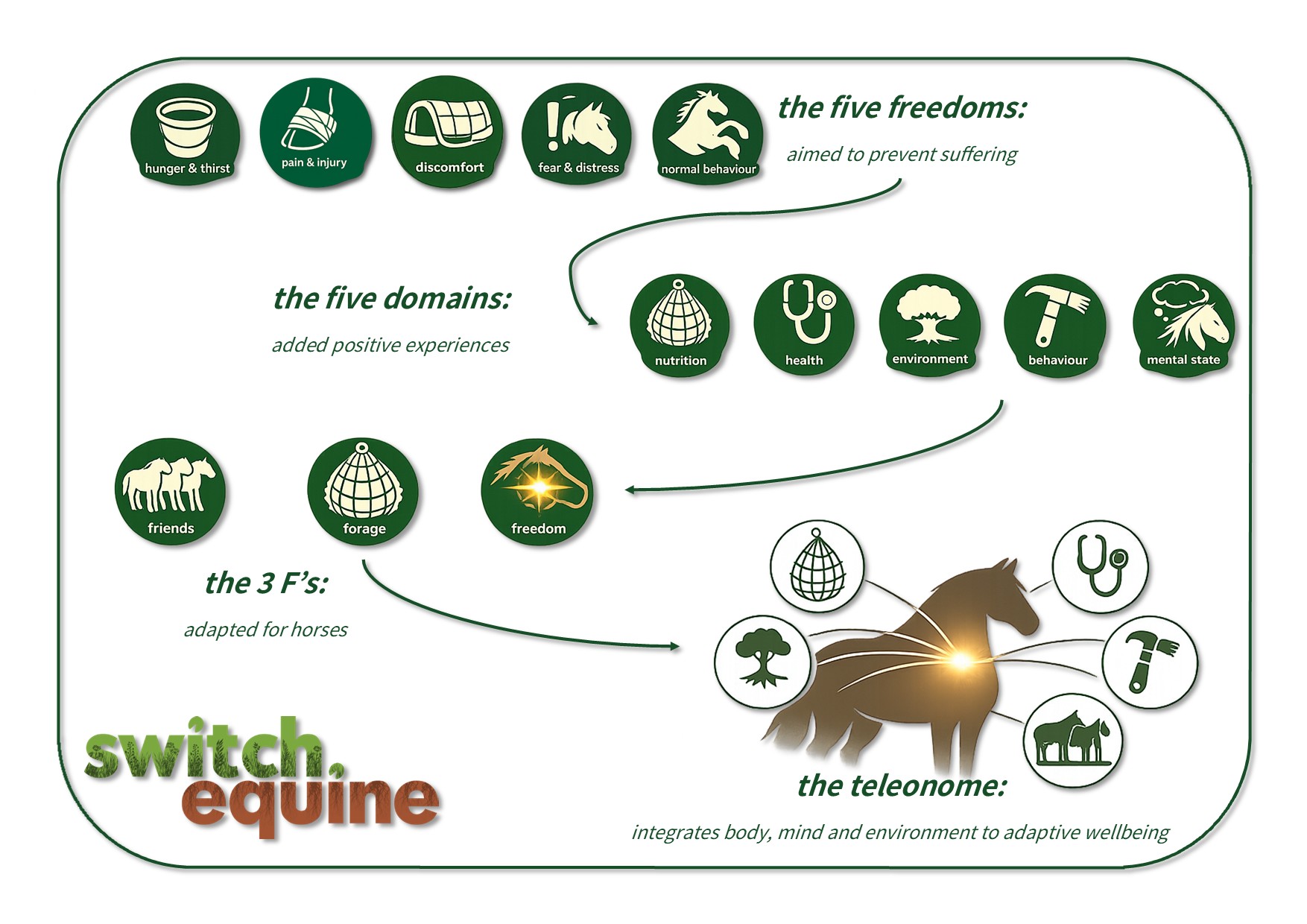
forage, friends, freedom.
The 3 F’s have become a kind of shorthand for “good horse care,” and for many horses, they’re a huge step forward.
But here’s the truth I’ve learned through science, practice, and the very real journey with my own horses:
The 3 F’s are a foundation — not a full picture.
You can provide all three and still have a horse who is anxious, shut down, unpredictable, chronically sore, or simply not thriving in the way you know they could.
For years, I worked to understand why.
Not by chasing trends, but by studying ecology, behaviour, physiology, soil science, and the lived experience of horses in real environments. I took a systems‑based approach long before I had a name for it.
And then, earlier this year, something remarkable happened:
everything I had been working towards was independently confirmed by researchers in New South Wales. Their newly published work on the teleonome finally gave scientific language to what I had been seeing in practice all along.
Let’s explore why this matters — and why it changes everything.
Welfare Has Evolved — And So Must We
Welfare science has changed dramatically over the last 60 years.
We’ve moved from simple checklists to a much deeper understanding of how animals experience the world.
Modern welfare isn’t about “providing enough.”
It’s about supporting the horse’s ability to adapt — emotionally, physically, socially, and environmentally.
That shift — from provision to adaptation — is huge.
And it’s exactly where the teleonome comes in.
The teleonome, introduced by researchers in New South Wales and published in Frontiers in Animal Science (2026), describes the entire adaptive system that allows an animal to survive, cope, learn, and thrive.
It includes:
- Adaptive capabilities — how the horse responds to challenge
- Affective regulation — how emotions shape behaviour
- Agency — the ability to make choices and exert control
- Environmental affordances — what the environment allows the horse to do
In everyday language:
The teleonome explains not just what a horse does, but why — and how their environment shapes every decision, emotion, and behaviour.
This is the missing link in most welfare conversations.
The 3 F’s tell us what horses need.
The teleonome tells us how horses function.
And that difference is everything.
Here’s something we rarely say out loud:
Most equine professionals only see one slice of the horse — and almost no one is looking at the system the horse is living in.
Think about it:
- Farriers see the feet
- Nutritionists see the diet
- Trainers see the behaviour
- Dentists see the teeth
- Vets see the symptom
- Physios see the muscle
Each is essential.
Each is skilled.
Each is doing their best.
But the horse doesn’t live in parts.
The horse lives in a complex, interconnected system of:
- soil
- forage
- movement
- social relationships
- emotional safety
- pain history
- learning history
- daily management
- and the environment we create
And here’s the truth:
No single professional is responsible for evaluating that system — or helping you improve it.
Which means the responsibility falls to the only person who sees the whole picture:
You.
And that’s a lot to carry without a framework.
Oisín: The Horse Who Forced Me to Rethink Everything
My understanding of welfare didn’t just come from a research papers.
It came from Oisín.
He was labelled dangerous.
I was told to shoot him.
He suffered injuries that nearly ended his life — and one that nearly ended mine.
The industry failed him.
When I rebuilt his life around choice, agency, appropriate forage, stable relationships, and an environment that supported his biology, he changed.
Not into a “perfect horse,” but into a horse who could finally:
- regulate
- express
- connect
- and be himself
His nervous system softened.
His behaviour made sense.
His true needs became visible.
And I’ve seen this pattern again and again — in rescue horses, “problem” horses, anxious horses, stoic horses, and foals raised with agency who grow into the most emotionally stable adults.
This isn’t luck.
It’s biology.
Why Environment Is the Foundation of Everything
At Switch Equine, we take a teleonome‑aligned view:
Environment isn’t a backdrop — it’s the foundation of welfare.
Environment includes:
- the soil beneath the horse’s feet
- the nutritional ecology of the forage
- the movement opportunities the land allows
- the social landscape of the herd
- the predictability and safety of daily life
- the emotional climate created by choice and agency
Every professional interacts with one piece of this puzzle.
But no one is responsible for the puzzle itself.
That’s why Switch Equine exists.
We help owners:
- connect the dots
- understand the whole system
- create resilient environments for resilient horses
- know who to call, when, and why
- interpret behaviour through the lens of biology and environment
- build systems that support adaptive capacity, not just comfort
Because the equine industry failed my horse — and I don’t want anyone else to go through that.
CARE: The Framework That Makes the Teleonome Practical
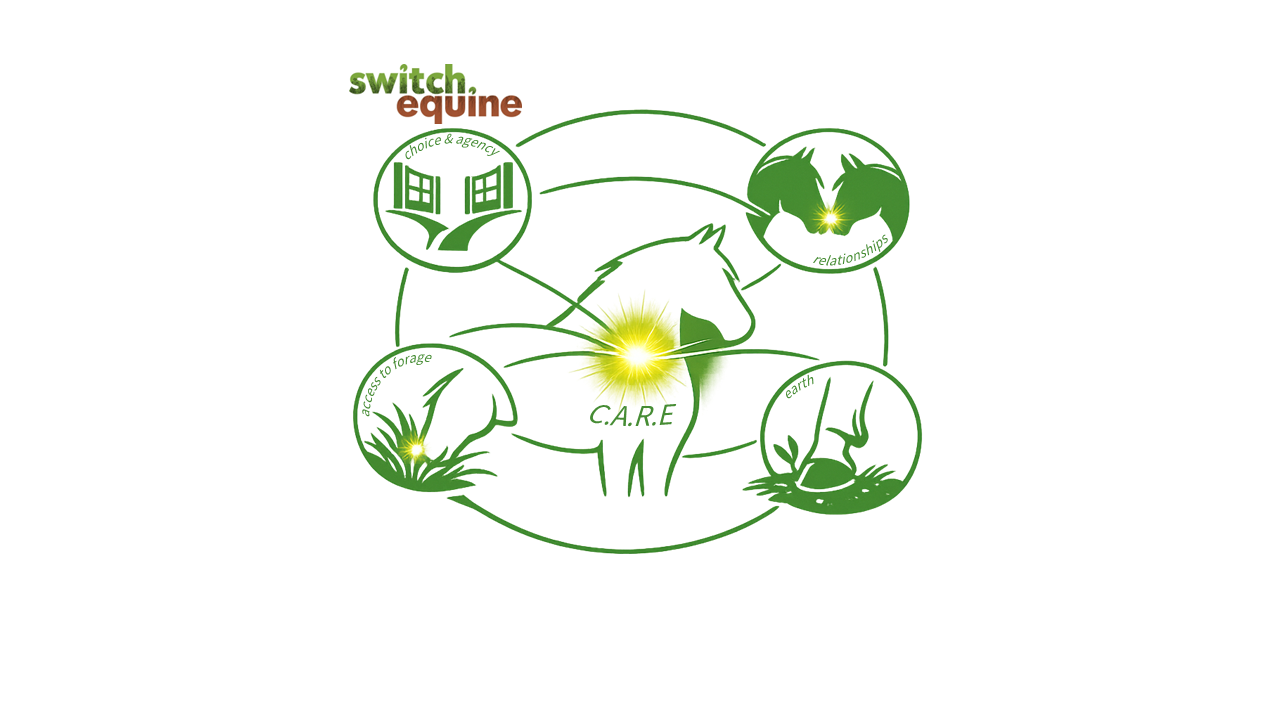
CARE is the framework I built because nothing else connected all the pieces.
It’s not a checklist.
It’s not a trend.
It’s not a set of rules.
It’s a systems‑thinking approach that helps you apply the teleonome in real life.
CARE helps you:
- understand the whole horse
- evaluate the whole environment
- make decisions that support adaptive capacity
- prevent problems instead of chasing symptoms
- build a life that allows horses to thrive
Here’s what it looks like:
C — Choice & Agency
Horses need meaningful control over their lives.
Agency isn’t optional — it’s biological.
A — Access to Appropriate Forage
Not just “ad‑lib hay,” but species‑rich, fibre‑diverse, soil‑informed nutrition.
R — Relationships
Not just proximity — stable, compatible, emotionally safe social groups.
E — Earth
The most overlooked element.
Soil health shapes everything from forage quality to metabolic resilience to hoof health.
CARE doesn’t replace your professionals.
It helps you integrate them into a coherent, horse‑centred system.
CARE is the practical expression of the teleonome.
Your horse’s welfare is not a list of provisions.
It’s not something you “achieve.”
It’s not static.
It’s a dynamic, relational, environmental process — and it requires us to evolve alongside our horses.
The 3 F’s gave us a foundation.
The teleonome gives us the science.
CARE gives us the framework.
And you give your horse the future they deserve.